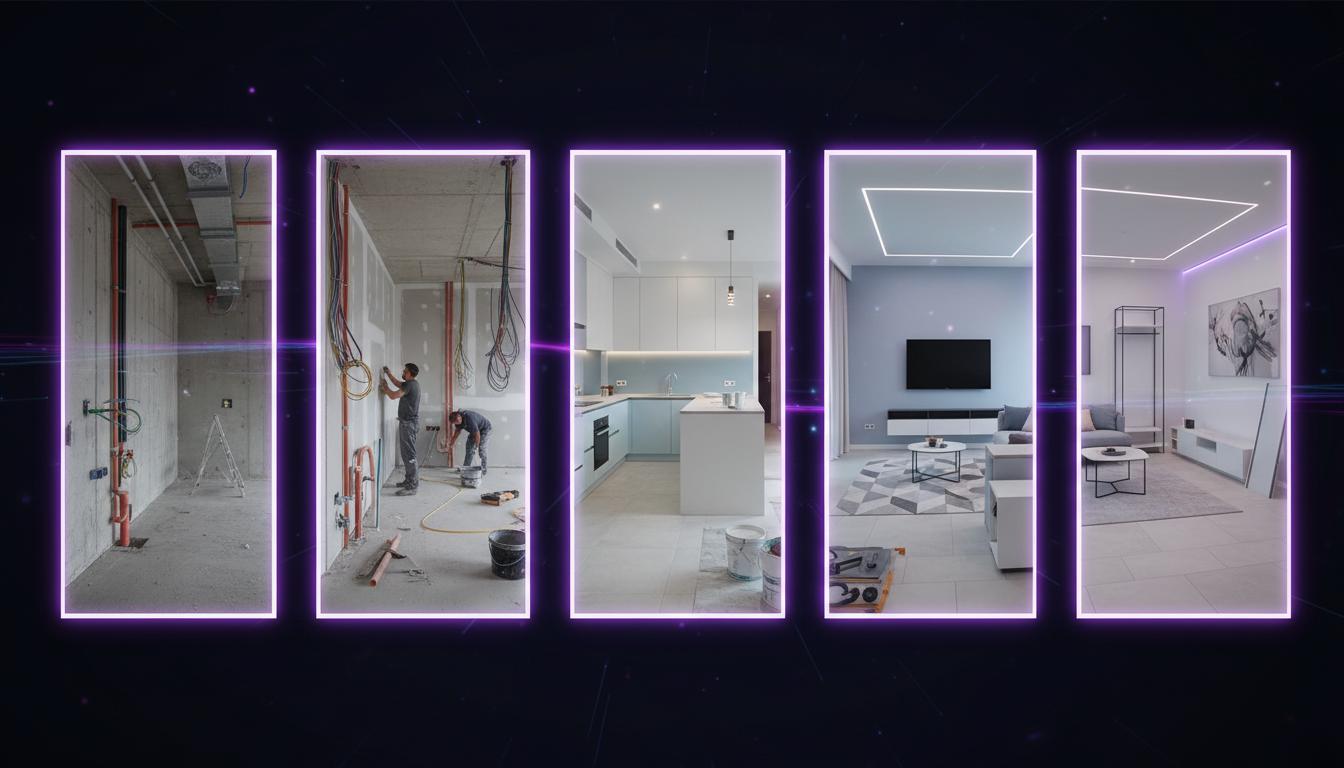
Why FOTON was founded, or how two disastrous renovations changed my life


When I arrived to take delivery of a renovated flat, there were three bathrooms inside and one toilet fitted. One.
That was the moment I understood that something is fundamentally wrong with the renovation trade. In fact I understood it twice.
A lesson in humility, Spanish edition
A few years ago I bought a flat in Spain as an investment. I was living in Poland at the time, so I ran the renovation remotely. I had nobody I trusted on the ground, no friend and no proven contractor. I had to rely on someone I knew only from phone calls.
I regularly received assurances that everything was on plan. Photos, updates, promised dates. I kept transferring the next instalment. It all sounded professional right up to the day we arrived with the family to a supposedly finished flat.
We found three bathrooms and one toilet. No seat, no washbasin. The only place to wash ourselves and the dishes was the bathtub. I genuinely did not know whether to laugh or call a lawyer.
More surprises followed: a drilled-through waste pipe with a hidden leak, badly fitted shower doors ruining a wooden frame, paint coming off the walls together with the masking tape, savings made on materials. Despite repeated requests, he never issued a single invoice. The final stage of the renovation was the contractor disappearing. My lawyers are still trying to find him.
The Polish sequel
I assumed the distance was to blame. I was far away, I could not keep an eye on things, it would be different in Poland. It was not.
The next renovation I ran on site. The contractor sent progress photos every day and everything looked professional: tools, materials, somebody always at work. In the photos somebody was always working. On site, not necessarily.
We settled by the hour, and for two months I kept hearing that another week would do it. When a new crew finally came in to assess the situation, the verdict was short: two months minimum, plus fixing what the previous lot had done. I stood in that flat with a distinct sense of déjà vu.
The moment it clicked
At the same time I was running a technology company working with data and AI. I had seen how technology monitors factories, logistics and production in real time. Any process can be measured, analysed and improved.
If I can track a courier with a parcel down to the street, why can I not track a renovation worth several hundred thousand?
On one side was a trade in which the client has minimal control and faces an enormous asymmetry of knowledge. On the other, mature technology: high-resolution cameras, sensors, image analysis and automated reports. I did not want to start another renovation company, I wanted to build a control tool that gives the client hard data instead of declarations. That is how FOTON came about.
Where the name comes from
I have been fascinated by quantum physics for a while now. I read about it, watch it, get drawn in, and at some point I started seeing things in it that describe what we do surprisingly well.
A photon is a quantum, the smallest indivisible portion of light energy. More interesting, though, is the observer effect: the very act of observation influences the behaviour of the photon. That is not a metaphor, it is physics. We see exactly the same thing on a building site. When a crew knows that every stage is being documented, they work more carefully. Nobody cuts corners, because corners cut are visible. There is no need to stand over anyone, it is enough that the record exists.
A photon is also simply light, and light is what renovations lack most. The client stands in the dark, not knowing what is behind the plaster or whether the pipes are the ones they paid for, and has to take somebody's word for it.
What it changes for the client
You do not have to call every day asking about progress, or trust photos taken specially for you from a flattering angle. You log in and see what happened today, what happened yesterday and what happened last week. How much material was used and how the work compares with the schedule. And if a dispute ever arises, you have evidence rather than recollections.
It sounds like a small change, but for someone who once stood in a flat with one toilet between three bathrooms, it changes everything.
What we are seeing so far
We are rolling FOTON out on a handful of sites and the response has been stronger than I expected. It turns out we hit a nerve, because a great many people have had the same experience. A different contractor, a different story, the same pattern: promises, delays, no control, frustration.
When monitoring and full visibility appear, the dynamic changes. It is not only the client who gains peace of mind. Good tradespeople appreciate it too, because their work is finally visible and documented, and they stop being lumped in with the cowboys.
What comes next
We want more than this. Today FOTON monitors and analyses what happens on site, but in time I want it to predict delays, budget overruns and risks before they materialise. We want a renovation to be as predictable as tracking a parcel. There is still a long way to go, but the direction is clear.
Because nobody should turn up to a supposedly finished flat and discover one toilet between three bathrooms.
Planning a renovation?
Check the costs in our calculator — fast and with no obligation.